Why Africa Needs Its Own Enterprise AI Platform
POPIA, data residency, and currency risk are not edge cases — they are the architecture. Here is why we are building the enterprise AI platform that should already exist on this continent.
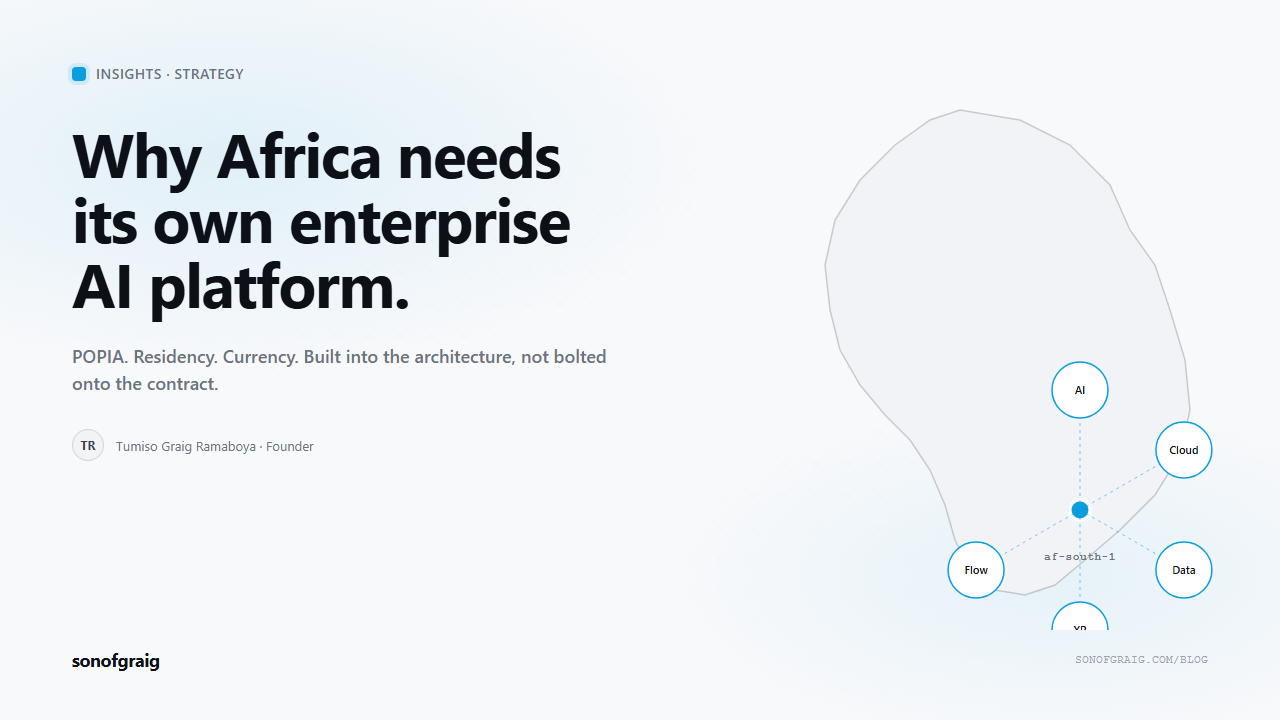
Every large South African enterprise running production AI today is making one of three trades. They are sending POPIA-regulated data across the equator to a US-hosted SaaS, paying for compliance theatre to make that defensible, or quietly underbuilding their AI roadmap because the procurement risk is too high. None of those are good answers. This is why we are building sonofgraig — the enterprise AI platform that should already exist on this continent, and the architecture choices behind it.
The three trades enterprise buyers are making right now
Run a procurement review on the most popular enterprise AI tools and three patterns dominate. The first is to host data offshore, usually in us-east-1, and treat the resulting POPIA Section 72 question as a paperwork problem solvable with a Data Processing Agreement and Standard Contractual Clauses. The second is to deploy on-premises or in a private VPC and accept that you have just rebuilt half a platform team to do it. The third is to slow down — quietly defer the AI roadmap until the regulatory air clears.
All three are responses to the same gap. There is no enterprise-grade AI platform that was designed from the start around South African regulatory conditions, priced in rand, and hosted in a region the Information Regulator does not need to be convinced is acceptable.
Why data residency is not a checkbox
South African enterprises hold personal information that the Protection of Personal Information Act (POPIA) regulates, and Section 72 restricts moving it across borders unless one of four narrow conditions applies. A US-hosted SaaS that reads, embeds, or fine-tunes on that data triggers a cross-border processing event whether or not the model output ever leaves the country. Residency is therefore not a marketing claim — it is the perimeter the law cares about.
The four conditions in Section 72 are: adequate protection in the receiving jurisdiction, binding contractual safeguards with the third party, consent from the data subject, or the transfer being necessary for a contract with that subject. The first is unavailable because South Africa has not declared any country to have adequate protection. The third and fourth do not scale to enterprise AI workloads that operate over millions of records belonging to customers who never signed a model-training waiver. That leaves contractual safeguards — which is where the DPA + SCC pattern comes from, and why it is now the default at the procurement table.
It is also why it does not actually solve the problem. SCCs put liability on paper. They do not prevent a US subpoena, a re-use of training data, or the operational gravity that pulls every new product feature toward the region where the platform actually lives. A platform headquartered in af-south-1, with its primary product team in South Africa, removes those questions at the architecture layer.
Why af-south-1 changes the maths
AWS opened the Cape Town region (af-south-1) in 2020. It is the only major hyperscaler region physically located in sub-Saharan Africa. For most of the years since, the region has been a destination for storage and basic compute — the AI services that mattered, including managed embeddings, vector search, and model hosting, lived in us-east-1 or eu-west-1. That is no longer true. Bedrock, OpenSearch with vector engine, SageMaker, and the supporting observability primitives are now generally available in af-south-1.
For the first time, an entire enterprise AI stack — ingestion, embedding, retrieval, inference, governance, and audit — can sit inside South Africa from the disk up. That is the architectural unlock. Every prior generation of "African AI" had to leak data across at least one trans-continental hop to deliver a working product. The current generation does not.
What we still see in 2026 procurement decks, however, is the previous generation's assumption baked into vendor selection. Most US-hosted AI platforms treat af-south-1 as a future tier, sometimes a roadmap line, rarely a launch region. The result is a procurement landscape in which "use our SaaS, accept the cross-border" is the default offer, and the local alternative is "build it yourself on AWS, hire a team, take 18 months." The middle option — a productised platform that runs natively in af-south-1 — is the one the market is missing.
The five-cluster thesis
The version of "build it yourself" most enterprises end up doing has a predictable shape. There is an AI capability layer — RAG, agents, fine-tuning, governance. There is a cloud and DevOps layer underneath it. There is a data and analytics layer for the inputs and the BI outputs. There is a creative and design layer because nothing ships without a brand surface. And there is a workflow layer that automates everything else. Five clusters, every time.
After eighteen enterprise AI engagements through the services arm of this business, we found ourselves rebuilding the same five clusters per client. The retrieval pipeline for the bank looked, structurally, identical to the retrieval pipeline for the insurer and the retrieval pipeline for the medical aid. The governance posture differed by which POPIA section was the priority worry, but the audit trail and the access controls converged. The data pipelines differed by source system, but the ingestion contracts and the lineage logging were the same. The five clusters productise.
That is the thesis behind sonofgraig: take the eighteen-project pattern and ship it as five SaaS clusters that share one identity layer, one observability stack, one POPIA-aligned audit trail, and one rand-denominated price list. The intelligence cluster — the AI Dev Platform — is the beachhead because it is where the value compounds fastest and where the build-it-yourself cost is highest. The other four clusters round out the platform an enterprise actually needs to run its AI in production.
Why we price in rand
The currency question is smaller than the residency question but it stings every quarter. South African enterprises buying USD-priced SaaS take the rand-dollar volatility directly into their OPEX line. A 12% currency move is not unusual in a single quarter. That is a finance team's problem, not an engineering one, but it shows up in renewal cycles as "we cannot commit to scale" — the exact decision an AI platform vendor needs the customer to make.
Pricing in rand removes the volatility, removes the per-renewal renegotiation, and removes the implicit message that the customer is a peripheral market. None of those are technical decisions. All of them are platform decisions. ZAR pricing is part of the architecture.
Who this is for
This platform is not for everyone. If your data has no POPIA exposure, if cross-border AI processing is fine in your threat model, and if your CFO is comfortable underwriting currency risk on a category that is going to be a meaningful percentage of your OPEX, the existing US-hosted players are well-tooled and worth your time.
It is for enterprises whose data the Information Regulator cares about, whose boards are starting to ask the cross-border question, whose internal AI teams have been quietly building the same stack twice, and whose customers expect rand-denominated contracts. It is for the financial services firms, medical aids, mutuals, telcos, government-adjacent SOEs, and large retailers who are running South African workloads and want their AI platform to behave the same way their core banking and core insurance systems behave: in-country, in-language, in-rand, in-audit.
What we are shipping and when
The first product out is RAG Studio, scheduled for Q4 2026. It is the lowest-risk way to put grounded AI into an enterprise workflow because it uses the customer's own documents as the source of truth and never trains on them. Agent Builder follows in Q1 2027 — a visual orchestration surface for the autonomous agents most enterprises are still hand-rolling. Fine-Tuning Ops and the Governance Hub round out the AI Dev Platform cluster across 2027. The other four clusters (Cloud + DevOps, Data + Analytics, Creative + XR, Workflow + Automation) are tracked in the public roadmap and ship sequentially.
Every cluster runs in af-south-1. Every cluster is POPIA-native. Every cluster is rand-priced. None of those are optional configuration — they are architectural commitments.
The deeper argument
There is a version of this post that argues the case purely on procurement economics — residency is cheaper, compliance is cheaper, currency is cheaper, total cost of ownership is lower. That argument is true and it is the one most CFOs respond to first. It is also the smaller argument.
The larger argument is that infrastructure shapes who gets to build. When the only enterprise AI platforms available to a South African company were built somewhere else for someone else, the design tradeoffs that platform inherited were not made with that company in mind. The defaults reflect a different regulatory environment, a different currency, a different language of compliance, a different relationship between government and industry. The customer adapts to the platform.
When the platform is built here, the defaults reflect what is here. POPIA Sections 11, 19, and 72 stop being checkboxes the customer has to defend and become invariants the platform enforces. Rand pricing stops being a quarterly negotiation and becomes a published list price. Residency stops being a paragraph in a contract and becomes a region in the console. The customer stops adapting; the platform fits.
That is why we are building this. It is also why we expect this category to mature quickly — the gap is too obvious, the timing is too favourable, and the next decade of enterprise AI on this continent will not run on foreign infrastructure.
Further reading
- POPIA Sections 11, 19 & 72: What They Mean for AI Architecture — the compliance deep-dive that complements this strategy piece.
- RAG, Agents, Fine-Tuning, Governance: The Four Pillars of an Enterprise AI Dev Platform — how the intelligence cluster is structured.
- Our POPIA posture — how we satisfy Sections 11, 19, and 72 by architecture rather than by contract.
- The thesis page — the services-to-software transition that funds this build.